
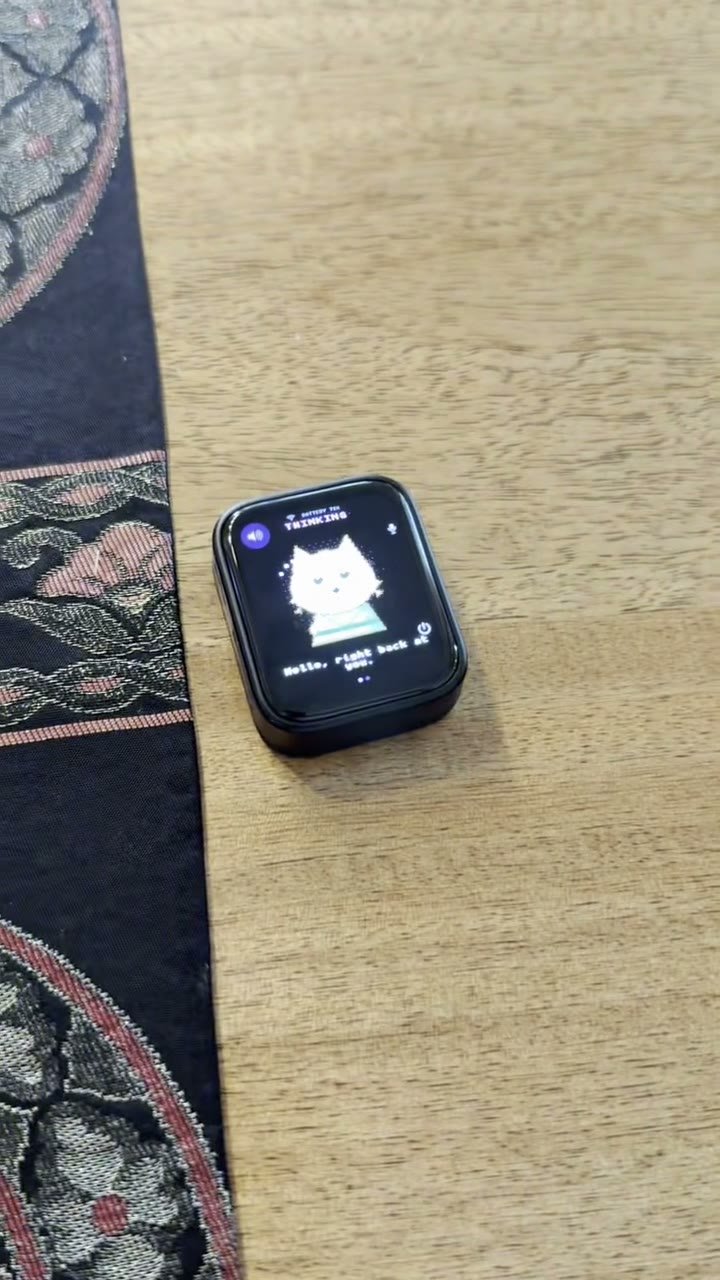
Last week this site shared concept renders of a pocket AI companion and labeled them, honestly, as design direction rather than a finished product. This article is the opposite of that. The device in the videos below is real, it is sitting on a desk in Michigan, it runs unplugged on its own battery, and when you ask it a question out loud, it answers you out loud.
It is called the Muse Charm, and it is the first working unit of a tiny AI desk pet built here at The AI Test Lab.
Watch It Work
This is the main demo, filmed on October 18, 2026, the same day the finished build came together. No renders, no voiceover, no editing tricks. You tap the charm, ask it a question out loud, it thinks for a moment, and it speaks its answer back through its own little speaker while the words appear as captions on its screen.
Watch for three details in that clip. First, the battery readout at the top of the screen, because the charm is running on its internal battery, not on a cable. Second, the status line changing to THINKING after the question, because the answer is being generated live, not played back from a recording. Third, the spoken reply arriving in the charm’s own voice while the caption shows on screen.
What the Muse Charm Is
The Muse Charm is a small, square, touchscreen gadget, small enough to sit in the corner of a desk or hang from a strap like an oversized keychain charm. A pixel character named Dash lives on its screen.
Press and hold to talk, and you are having a voice conversation with Muse, the AI assistant. Your speech is picked up by the built-in microphone and transcribed, Muse answers, and the answer comes back to you two ways at once, as text on the screen and as spoken audio in a natural voice. The charm uses a streaming speech build, which means it starts speaking the first sentence of a reply while the rest is still being generated, so the conversation feels like a conversation instead of a download.
Between conversations, Dash is not a blank screen. The character idles, reacts, gets hungry, gets bored, and goes to sleep at night. Which brings us to the other half of the product.
It Is Also a Pet
Layered on top of the AI is a Tamagotchi style virtual pet, built into the same firmware. Dash has three stats that drift over time: hunger, mood, and energy. You keep them up the way you would expect. Feed it, play with it, and tap the screen to pet it, which gets you the happy reaction in this second clip.
Two design choices are worth calling out. The pet sleeps at night, roughly 10 PM to 7 AM, instead of demanding attention around the clock. And there is deliberately no death mechanic. If you ignore the charm for a week, Dash will be hungry and bored when you come back, but it will not be dead, and it will not guilt you about it. A desk companion should lower your stress, not add a new source of it.
The Hardware Underneath
The charm is built on a Waveshare ESP32-S3 Touch AMOLED 1.8 development board, chosen because it packs an unusual amount into a tiny square:
- A 1.8 inch AMOLED touchscreen at 368 by 448 resolution, bright and sharp enough for a readable caption and a character with expressions
- An ESP32-S3 chip with 16 MB of flash storage and 8 MB of RAM
- A built in microphone and speaker with a proper audio codec, which is what makes a real voice conversation possible at this size
- WiFi, which the charm uses to reach Muse
- A small 3.7 volt, 200 mAh lithium battery fitted inside the case, charged over USB-C, so the unit works untethered
- Motion and timing hardware on board that the pet layer uses for play and sleep
One honest technical note. This exact board was not officially supported by the Muse gadget software when we started, and we could not find an existing port for it anywhere. The display and touch drivers had to be ported and the board support written from scratch, borrowing driver code from other open projects for the same screen. Getting a clean build to flash and boot on this specific board was most of the work. The talking, by comparison, was the fun part.
If the hardware sounds familiar, it should. It is the same board family behind the Hatchi concept we wrote about earlier this month, which you can read in Meet Hatchi: The Pocket AI Companion We Are Building. Hatchi was the idea on paper. The Muse Charm is what happened when we actually built one for an adult desk instead of a concept page.
Why a Gadget, When Your Phone Already Has AI Apps?
Because presence changes the relationship. A phone app is one icon among two hundred, buried behind notifications, and opening it feels like starting a task. The charm is a physical thing that lives in one place, does one job, and has a face. You glance at it the way you would glance at a pet. You talk to it without unlocking anything, typing anything, or looking at a feed.
That is the product idea being tested here. Not another chatbot window, but a small object whose whole job is to be your AI, in person, all day.
The Honest Status of This Product
This site labels concept work as concept work, so here is the equivalent honesty for a working prototype.
The Muse Charm you see in these videos is unit number one, a personal build. It runs on its owner’s own Muse account, and it is not for sale in this form. The gadget software it builds on is licensed for personal use, so a retail version would need a different arrangement, or a different AI brain under the same pet hardware, and that question is being worked through separately and openly rather than being papered over.
What is being tested right now is the experience itself. How fast the spoken replies feel across a whole day. How the battery holds up in real use. Whether the pet layer stays charming after a month or starts to feel like a chore. Two more boards are already on the shelf reserved for a separate family version, which will be its own build and its own story.
Follow along here at The AI Test Lab. The next update will be the one month report: what it is actually like to live with an AI on your desk that talks back.
1 thought on “Meet the Muse Charm: A Tiny AI Desk Pet That Actually Talks Back”
Comments are closed.